

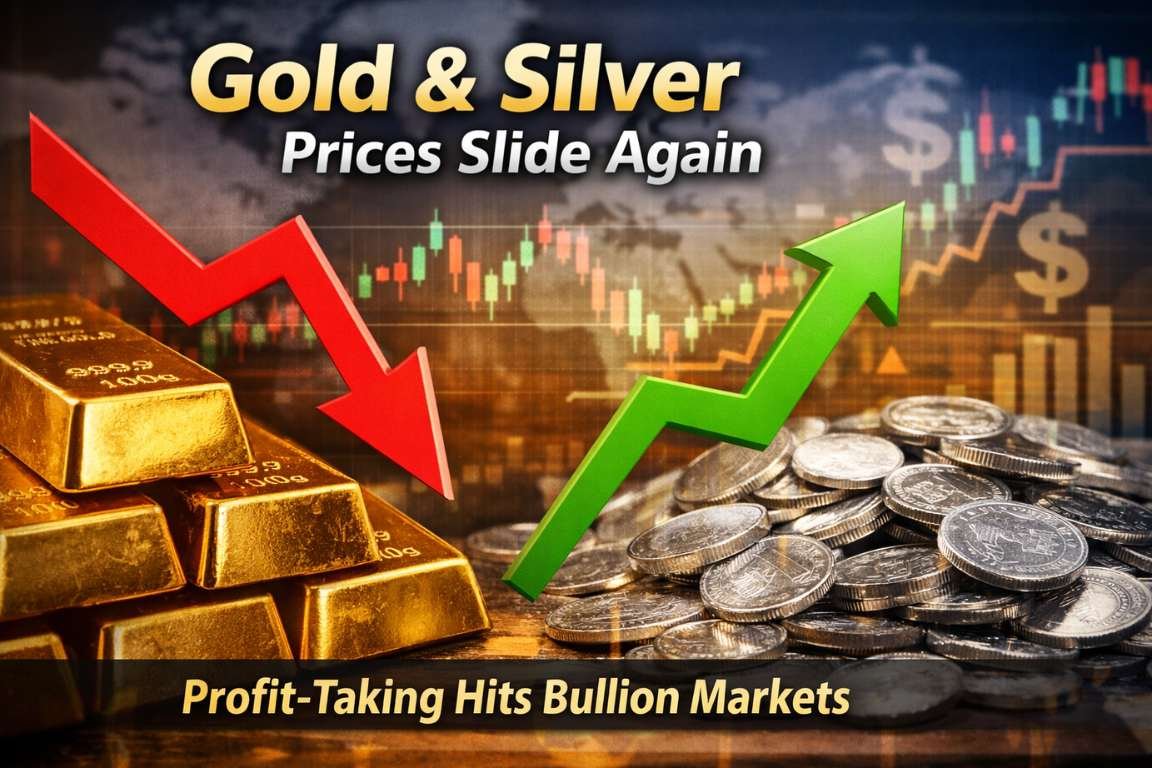
Silver and Gold prices extended losses for a third consecutive session on February 2
As aggressive profit-taking followed last month’s sharp rally that had pushed both metals to record highs. Weak domestic and global cues, along with a firm US dollar and shifting expectations around US monetary policy, weighed on bullion prices.
On the Multi Commodity Exchange (MCX), silver futures saw heavy selling pressure. In the previous session, MCX silver futures plunged ₹26,273, or 9%, to settle at ₹2,65,652 per kilogram. April gold futures declined 3%, or ₹4,592, closing at ₹1,47,753 per 10 grams.
The sell-off marked a sharp reversal after gold and silver had rallied strongly through January, driven by safe-haven demand and expectations of interest rate cuts. Market participants said the recent correction was triggered by profit-booking and the unwinding of leveraged positions, leading to broad-based selling across precious metals.
Gold and silver exchange-traded funds (ETFs) also witnessed sharp volatility. During early trade, several ETFs crashed by nearly 20% before recovering up to 10% by mid-session, reflecting heightened nervousness among investors as prices corrected sharply from record levels.
Global factors further added to pressure on bullion prices. The US dollar remained firm as investors assessed the likely policy direction of the Federal Reserve following the nomination of Kevin Warsh as the next Fed Chair. A stronger dollar typically weighs on gold, as it makes the metal more expensive for buyers using other currencies.
The sharp sell-off in gold was largely triggered by US President Donald Trump’s decision to nominate Warsh to succeed Jerome Powell, whose term ends in May. Analysts said the move reduced policy uncertainty, dampening safe-haven demand and prompting investors to lock in gains near record highs.
In global markets, spot gold fell as much as 10% earlier in the session before trimming losses, while silver also saw steep intraday declines. Commodities such as oil and industrial metals weakened as well, reflecting broader risk-off sentiment across markets.
Despite the near-term correction, some global brokerages remain constructive on gold’s medium- to long-term outlook, citing sustained central bank demand and diversification away from paper assets. However, analysts caution that volatility may persist in the short term as markets adjust to tighter financial conditions and evolving expectations around US monetary policy.
Going ahead, investors are expected to closely track further signals from the Federal Reserve, movements in the US dollar, and global risk sentiment to gauge the next direction for gold and silver prices.